Milky Way Season at Bryce Canyon: When to Shoot
The galactic core is photographable at Bryce from roughly February through October, with the prime window running May through September. Here is the month-by-month breakdown — including approximate core rise times and the moon math that matters more than any of it.
How Core Season Works
The "Milky Way season" everyone talks about is really galactic core season. The band of the Milky Way is overhead in some form every clear night of the year — but the dense, photogenic core region around Sagittarius and Scorpius is only above the horizon during dark hours for part of the year. From November through most of January it travels with the sun and is unphotographable.
At Bryce Canyon's latitude (~37.6°N), the cycle runs like this: the core first peeks above the southeast horizon in the pre-dawn hours of February, rises about two hours earlier with each passing month, dominates the night from May through September, and finally sets with evening twilight by late October. Early season favors night owls who shoot at 4 a.m.; late season favors anyone who wants the core up at a civilized 9:30 p.m.
Core Rise Times by Month
These are approximate mid-month figures for Bryce Canyon, local time, assuming a reasonably flat southeast horizon. They will drift 30–60 minutes across each month and with your exact viewpoint horizon — treat them as planning anchors, then confirm your specific date in PhotoPills or Stellarium. We would rather give you honest approximations than fake precision.
| Month | Core rises (approx.) | Usable dark window | Notes |
|---|---|---|---|
| Feb | ~5:00 a.m. | 1–1.5 h pre-dawn | Short, frigid, empty rim |
| Mar | ~3:30 a.m. | ~2 h pre-dawn | Low core, SE horizon |
| Apr | ~1:30 a.m. | ~3 h | Rising-core compositions begin |
| May | ~11:30 p.m. | 4–5 h | Prime: low core over hoodoos |
| Jun | ~9:30 p.m. | Most of the night | Prime: core up by end of twilight |
| Jul | Up at dark | Until ~4 a.m. | High arch; monsoon clouds possible |
| Aug | Up at dark | Until ~2–3 a.m. | Arch panoramas; Perseids mid-month |
| Sep | Up at dusk | Until ~midnight–1 a.m. | Core leans SW; dry, steady air |
| Oct | Up at dusk | 1–2 h after dark | Last call; core sets early |
| Nov–Jan | — | — | Core lost in sun; shoot Orion & winter band |
Moon Phase: The Variable That Outranks Everything
You can nail the month, the viewpoint, and the settings, and a bright moon will still erase the core. Moonlight scatters across the whole sky; anything past about 40% illumination washes the core's structure into gray. The planning rules:
- Aim for the window within ~5 days of new moon. That gives you 8–10 genuinely dark nights per lunar cycle.
- Use the gaps. A waxing moon sets in the evening — shoot after moonset. A waning moon rises late — shoot between astronomical dusk and moonrise. PhotoPills' planner shows both against core position.
- A thin crescent isn't fatal. Under ~15% illumination, low on the horizon and behind you, the moon can even add gentle foreground light on the hoodoos. Some of the best Bryce frames use it deliberately.
- Astronomical darkness matters too. In midsummer at this latitude, true darkness doesn't start until roughly 90 minutes after sunset. Don't burn your moon window on twilight.
Month first (core position) → new-moon window second (darkness) → weather last (you can't book around it, but Bryce's high desert averages a large share of clear nights, and summer monsoon storms usually clear by late evening). Then pick your viewpoint from the spots guide.
What Each Part of the Season Shoots Like
February–April: The Solitude Window
Pre-dawn core, single-digit to 20s°F, and a realistic chance of being the only photographer in the park. The core sits low on the southeast horizon — ideal for compositions where it appears to rise directly out of the hoodoo field at Sunset or Inspiration Point. Snow on the hoodoos under starlight is a frame very few people own. Check trail status; rim paths hold ice well into spring, and winter layering and battery management stop being optional.
May–June: Prime Time
The consensus best months. The core rises in the late evening, low and angled over the amphitheater; nights are long enough for multiple compositions; and daytime weather is stable. This is when the classic Bryce shot — galactic core climbing out of the Silent City — lines up at the main viewpoints. It is also when guided night tours are most valuable, because the best 90 minutes of core position are predictable and a guide puts you in the right spot for them instead of you finding it on attempt three.
July–August: The High Arch and the Monsoon
The core is already up when darkness falls and the full galactic arch spans the sky — panorama season. The complication is the North American monsoon: afternoon thunderstorms are common, but they typically collapse after sunset and leave behind rinsed, exceptionally transparent air. Mid-August adds the Perseid meteor shower; an intervalometer sequence pointed over the amphitheater during the peak will catch meteors in multiple frames.
September–October: Short, Sweet, Stable
The core stands to the south-southwest at dusk and sets progressively earlier — by late October you get barely an hour. But the air is dry and steady, the aspens on the plateau turn gold for daytime shooting, and south-facing Paria View aligns perfectly with the evening core. For a photographer who hates 3 a.m. alarms, late September is quietly one of the best bets of the year.
What the Sky Can Deliver in Season
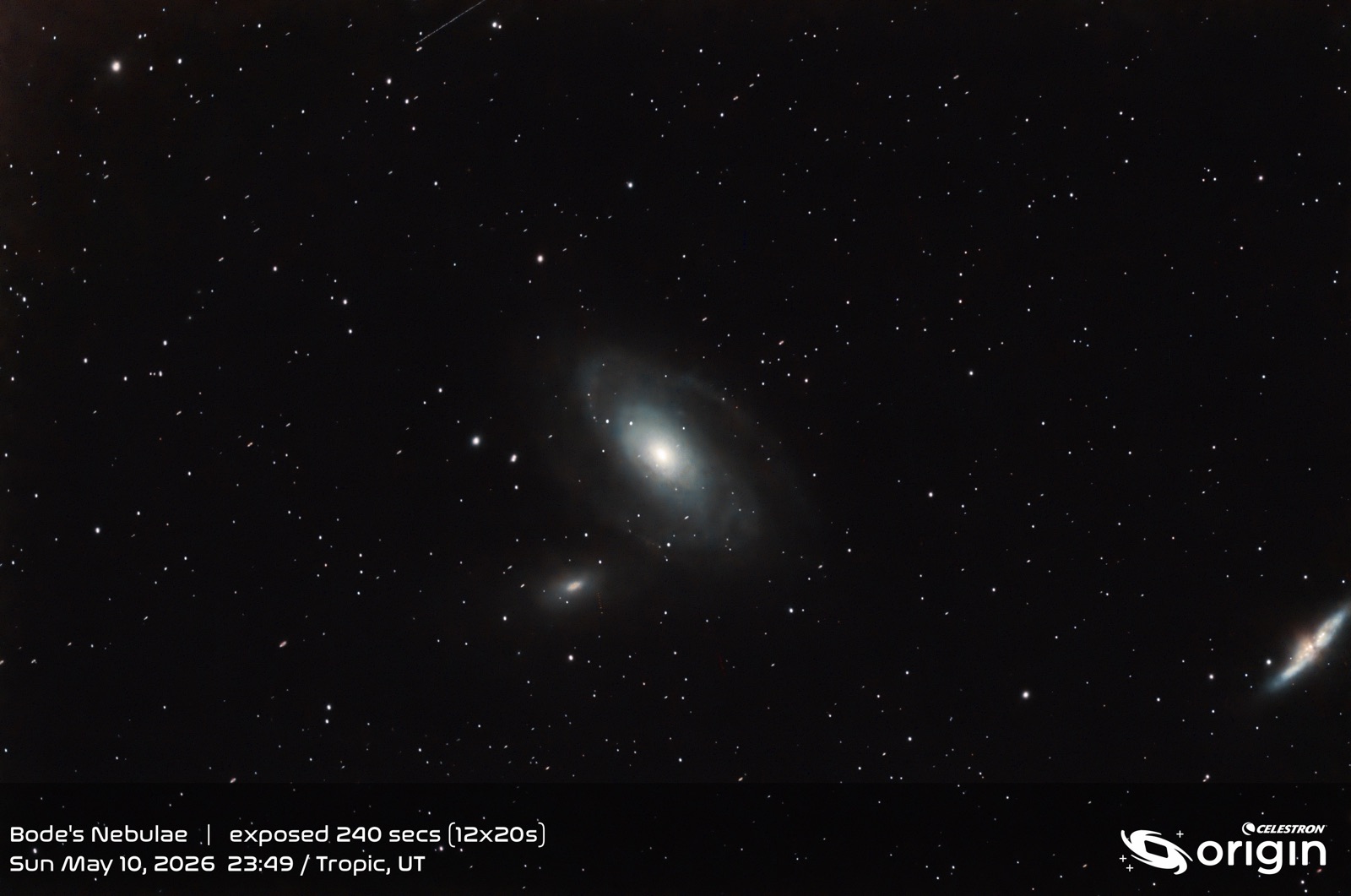
Under Bortle 2 skies during core season, the sky above Bryce Canyon delivers real deep-sky detail — not just Milky Way structure. This is Bode's Galaxies (M81 and M82), captured during a Bryce Canyon Stargazing tour in May 2025 from the tour site near Tropic, Utah. Galaxies 12 million light-years away, resolved from the same sky your camera will see.
Lock In Your Dates
Once you have a month and a new-moon window, two more pages finish the plan: the viewpoint guide to match composition to core azimuth, and the gear checklist for the cold-night realities at 8,000 feet. And if your window is short — one or two nights on a road trip — stack the odds with a guide.
Ready to shoot? Go with a guide who knows the rim.
Bryce Canyon Stargazing's guides are on the rim through every core season. Book your night tour for the new-moon window and arrive at the right viewpoint with the core already in position.